New Year's Day, 2015.
Starving in Plain Sight.
I put a turkey in the oven at 9 a.m., slammed the door, turned around, and hit the floor.
Cheek on the cold kitchen tile, no memory of going down.
I'd dropped from 240 pounds to 160 in a few months and I was still falling.
Bones showing up that I hadn't seen in years, and food had stopped tasting like anything good.
Everything tasted like wrongness, and my body had been making its opinion very clear for months.
The nausea never stopped. Not once.
I was living in the bathroom, bolted there by diarrhea so constant and so brutal that my poor butthole was raw, burning.
There was no position that helped, and no relief anywhere.
All I could get down was peppermint tea.
I wasn't a person who ate meals anymore.
I was a person who lost ground every single day and had no idea how to stop it.
The ER
My husband Charlie got me to the ER.
After hours of tests and waiting, a nurse came through the room pointing at people: "You, you, you — you can go home."
She pointed at me too, and something cracked open in my chest I didn't know was there.
I heard myself say it louder than I meant to: "But I can't eat or drink anything. I'll die!"
The doctor looked me in the eye and said, "Sorry, sweetheart. There's no magic bullet."
"I wasn't looking for a magic bullet. I just wanted someone to help me find a way — any way, in any form — to get nourishment into a body that had stopped accepting it."
I was so done with the nausea I genuinely wanted to reach down my own throat, grab my stomach, rip it out, throw it away and just be finished with the whole thing.
They gave me a glucose IV, stabilized me enough to go home, and that was it.
That was everything modern medicine had for me that day.
The next morning I went to my naturopath and not with hope, I was past hope.
This was a last desperate move, one final attempt to find any solution at all before my body made the decision for me.
Organ failure followed by the morgue was the only logical conclusion left if he couldn't help me, and we both knew it.
He pulled out a catalogue, found a page, tapped it, and said, "It won't be easy, but if you can get two of these down every day, you'll get there."
He explained exactly how to do it.
What he handed me that day is the same product that forms the backbone of everything I now recommend, and I'll tell you more about it at the end of this guide.
But first I had to actually prove it could work, and what I learned shortly after is that I only had ten weeks to do it — ten weeks before surgery.
So I went home and had it shipped to my door.
Paget disease of the nipple
Not long after that, the fourth biopsy on my grotesquely rashed nipple that every doctor had been dismissing for months, calling it eczema, waving me out the door - finally got it right.
Paget disease of the nipple.
A rare form of breast cancer where a tumor in the milk ducts behind and beneath the nipple sends cancer cells travelling upward through the ductal tissue until they break through the skin itself.
That's why it looks like a rash, and why they kept missing it.
We'd already removed a tumor from those ducts twice before.
My surgeon and I agreed fast: mastectomy, it was booked for ten weeks out.
Ten weeks to get strong enough to survive surgery and I could not eat.
I'd already brought the word cachexia to my doctors and they'd laughed me out of the room. Actually laughed!
So I kept Googling at 2 a.m., kept reading, kept trying to understand what was happening to me since the people who were supposed to know clearly weren't going to tell me.
So every day for those ten weeks, I got two servings down.
One ounce at a time, slow enough that each ounce was gone in about fifteen minutes, then I'd start again.
Gently convincing a body that had every reason not to trust food, to try one more time.
Some days it took until dinner, some days I sat there with the glass in my hand and had a full argument with myself before the first sip.
"I didn't stop, because the alternative was lying down and letting my body finish the job, and I wasn't ready to do that."
I could do two ounces instead of one, it got a little easier each week until one day it was easy, too easy, and I knew.
I was ready to start introducing food the way you would for a newborn — the smallest, gentlest things first.
Treating my gut like it was learning the world from scratch. Because it was.
The Daffodils
March 27th. I made it to the table.
One surgery, two surgeons where my breast surgeon did the mastectomy, and while I was still under, the plastic surgeon placed the tissue expander.
I woke up and Charlie drove me home the same day.
The 28th, flowers started arriving.
My tribe had rallied, surprising me with gorgeous flower arrangements that kept coming to the door, one after another, and Charlie brought each one to me on the couch.
Then one more arrived and he went to get that too, assuming it was another one for me, but I knew otherwise.
He opened the card, and I watched his face change the moment he realized that his sick, barely-there wife had somehow thought ahead.
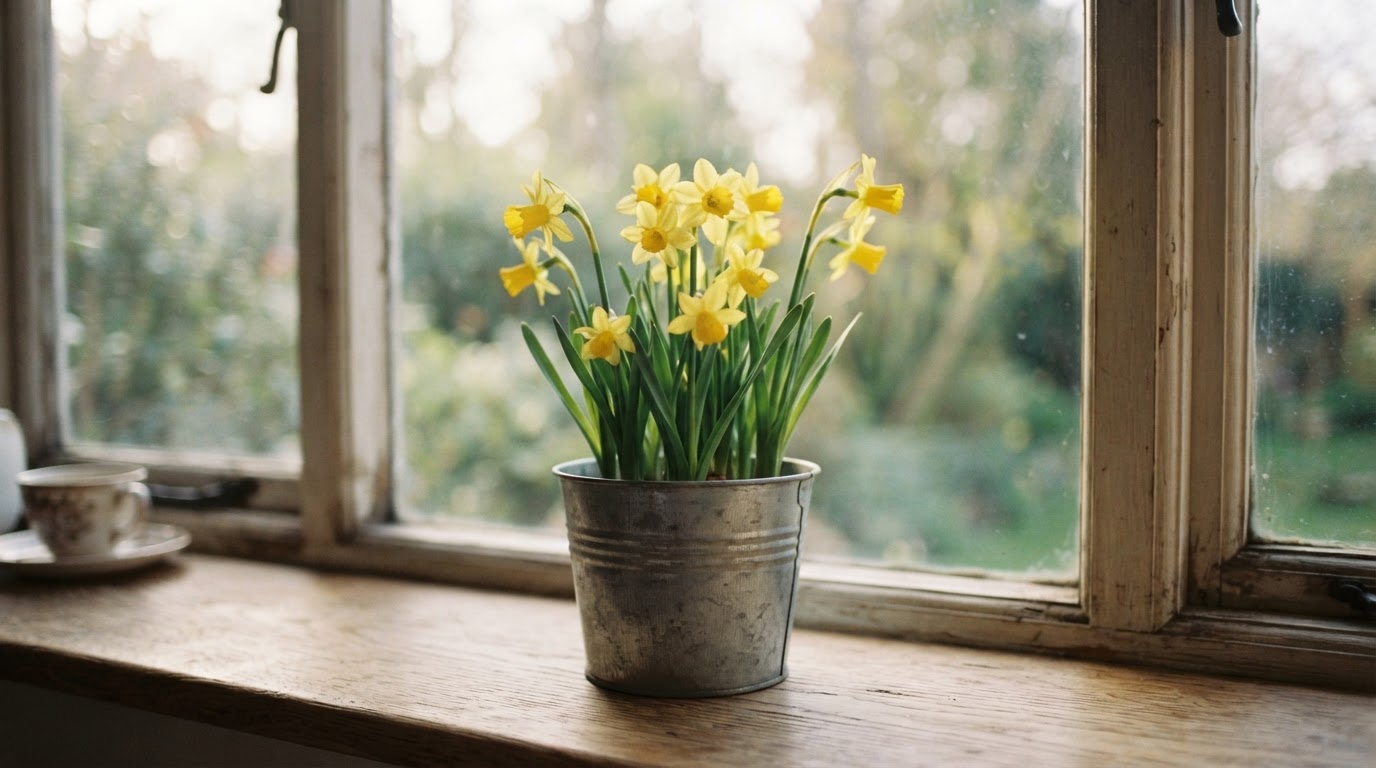
Had somehow planned and arranged for a tin planter full of daffodils to arrive for their tin anniversary while she was recovering from cancer surgery.
He had no clue this was coming, his favourite flower, and that look on his face is one that I will keep in my heart for as long as I live.
The Second Catastrophe
About three days home I knew something was wrong inside my chest.
Not discomfort — sharp, stabbing pains, like someone had gotten in there with tiny scalpels and wouldn't stop doing damage.
I called. I went in. I told them something was not right every single time but was met with:
"You're too sensitive."
"It's perfect."
"Go home."
Three weeks of that — calling, showing up, being sent home to rest and wait.
While the infection built from rib fragments the plastic surgeon's tissue expander had broken loose.
He tightened it so hard against my chest wall that it fractured my ribs.
Nobody listened. I kept calling. They kept sending me home, calling me a wimp without actually saying it out loud.
Until my temperature hit 42 degrees and the sepsis showed up on the surface of my chest where they could no longer pretend not to see it.
When I arrived at the hospital that day the staff were different, soft and gentle in a way that stopped me cold.
Immediate in a way that said something before anyone spoke, and the next thought that moved through my mind was quiet and certain: they know I'm dying.
"They know I'm dying."
The hospital was home for three weeks after that.
The first week I don't remember at all, I'm guessing I surrendered, because there was nothing left to fight with, and sometimes that's the most honest thing a body can do.
Apparently the drugs they gave me had me charming the entire ward and making fast friends with everyone, so at least someone was having a good time.
By the second week I was coherent enough to remember things, and Charlie was there every single day with my sips.
That thread, that one small daily thing my naturopath had given me ten weeks before any of this, was still there. Still holding.
Once I came home there were nine months of going to the wound clinic every second day to have strangers clean the hole in my chest where a personal part of my body used to be.
It was always excruciating, and I wasn't healing up very well.
Toward the end of those nine months, a nurse stabbed herself on one of the shards of bone still inside me.
That's what led to finding the bone infection nobody had named - what was stalling my healing process.
That bought me six weeks of IV antibiotics through a PICC line, then six more weeks of oral antibiotics right after.
That's what triggered the second catastrophe. The quiet one. The one nobody warned me about, and the one I'm most determined to warn you about now.